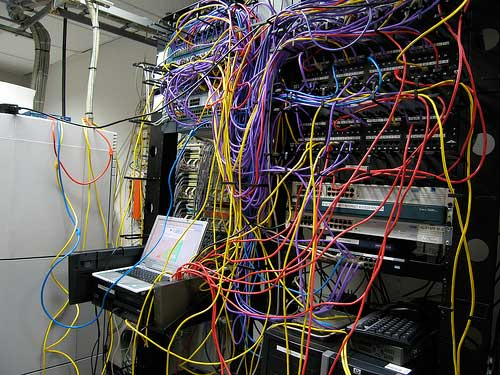
%% (fortunes) A novel approach is to remove all power from the system, which removes most system overhead so that resources can be fully devoted to doing nothing. Benchmarks on this technique are promising; tremendous amounts of nothing can be produced in this manner. Certain hardware limitations can limit the speed of this method, especially in the larger systems which require a more involved & less efficient power-down sequence. An alternate approach is to pull the main breaker for the building, which seems to provide even more nothing, but in truth has bugs in it, since it usually inhibits the systems which keep the beer cool. %% After sifting through the overwritten remaining blocks of Luke's home directory, Luke and PDP-1 sped away from /u/lars, across the surface of the Winchester riding Luke's flying read/write head. PDP-1 had Luke stop at the edge of the cylinder overlooking /usr/spool/uucp. "Unix-to-Unix Copy Program;" said PDP-1. "You will never find a more wretched hive of bugs and flamers. We must be cautious." -- DECWARS %% Hack placidly amidst the noisy printers and remember what prizes there may be in Science. As fast as possible get a good terminal on a good system. Enter your data clearly but always encrypt your results. And listen to others, even the dull and ignorant, for they may be your customers. Avoid loud and aggressive persons, for they are sales reps. If you compare your outputs with those of others, you may be surprised, for always there will be greater and lesser numbers than you have crunched. Keep others interested in your career, and try not to fumble; it can be a real hassle and could change your fortunes in time. Exercise system control in your experiments, for the world is full of bugs. But let this not blind you to what virtue there is; many persons strive for linearity and everywhere papers are full of approximations. Strive for proportionality. Especially, do not faint when it occurs. Neither be cyclical about results; for in the face of all data analysis it is sure to be noticed. Take with a grain of salt the anomalous data points. Gracefully pass them on to the youth at the next desk. Nurture some mutual funds to shield you in times of sudden layoffs. But do not distress yourself with imaginings -- the real bugs are enough to screw you badly. Murphy's Law runs the Universe -- and whether or not it is clear to you, no doubtB*n dS = 0. Therefore, grab for a piece of the pie, with whatever proposals you can conceive of to try. With all the crashed disks, skewed data, and broken line printers, you can still have a beautiful secretary. Be linear. Strive to stay employed. -- Technolorata, "Analog" %% The wise programmer is told about the Tao and follows it. The average programmer is told about the Tao and searches for it. The foolish programmer is told about the Tao and laughs at it. If it were not for laughter, there would be no Tao. The highest sounds are the hardest to hear. Going forward is a way to retreat. Greater talent shows itself late in life. Even a perfect program still has bugs. -- Geoffrey James, "The Tao of Programming" %% ACCEPTANCE TESTING: An unsuccessful attempt to find bugs. %% As I was passing Project MAC, I met a Quux with seven hacks. Every hack had seven bugs; Every bug had seven manifestations; Every manifestation had seven symptoms. Symptoms, manifestations, bugs, and hacks, How many losses at Project MAC? %% As long as there are ill-defined goals, bizarre bugs, and unrealistic schedules, there will be Real Programmers willing to jump in and Solve The Problem, saving the documentation for later. %% Beware of bugs in the above code; I have only proved it correct, not tried it. -- Donald Knuth %% bug, n: An elusive creature living in a program that makes it incorrect. The activity of "debugging", or removing bugs from a program, ends when people get tired of doing it, not when the bugs are removed. -- "Datamation", January 15, 1984 %% Each new user of a new system uncovers a new class of bugs. -- Kernighan %% Ever wondered about the origins of the term "bugs" as applied to computer technology? U.S. Navy Capt. Grace Murray Hopper has firsthand explanation. The 74-year-old captain, who is still on active duty, was a pioneer in computer technology during World War II. At the C.W. Post Center of Long Island University, Hopper told a group of Long Island public school adminis- trators that the first computer "bug" was a real bug--a moth. At Harvard one August night in 1945, Hopper and her associates were working on the "granddaddy" of modern computers, the Mark I. "Things were going badly; there was something wrong in one of the circuits of the long glass-enclosed computer," she said. "Finally, someone located the trouble spot and, using ordinary tweezers, removed the problem, a two-inch moth. From then on, when anything went wrong with a computer, we said it had bugs in it." Hopper said that when the veracity of her story was questioned recently, "I referred them to my 1945 log book, now in the collection of the Naval Surface Weapons Center, and they found the remains of that moth taped to the page in question." [actually, the term "bug" had even earlier usage in regard to problems with radio hardware. Ed.] %% Heuristics are bug ridden by definition. If they didn't have bugs, then they'd be algorithms. %% If graphics hackers are so smart, why can't they get the bugs out of fresh paint? %% Never do programs contain so few bugs as when no debugging tools are available. -- Niklaus Wirth %% Testing can show the presense of bugs, but not their absence. -- Edsger W. Dijkstra %% The bugs you have to avoid are the ones that give the user not only the inclination to get on a plane, but also the time. -- Kay Bostic %% The number of computer scientists in a room is inversely proportional to the number of bugs in their code. %% The reason we come up with new versions is not to fix bugs. It's absolutely not. -- Bill Gates %% There are never any bugs you haven't found yet.